
Objects
Rosebud Promise badge, 1914
The first badge made for the youngest girls in Guiding: a metal rosebud, from the single year before Rosebuds became Brownies.
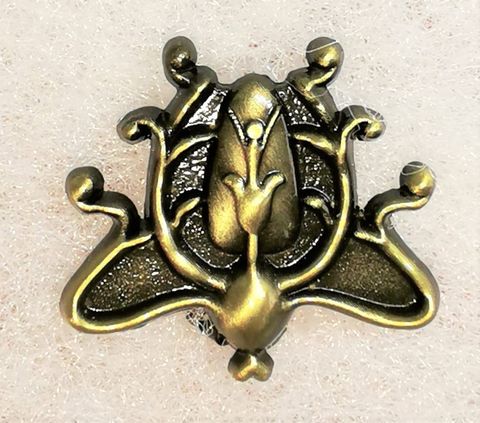
This was the first badge for the Rosebuds, the junior section created in 1914. It is a small brass-coloured metal badge: a stylised bud at the centre, framed by curling tendrils. The Norfolk archive credits the design to Agnes Baden-Powell.[1] Evidence status: Unconfirmed We have not yet found a document of the time that confirms she designed it, so that attribution is in some doubt.
The Promise it stood for
The badge marked a girl’s PromiseThe commitment members are invited to make when they feel ready. Its wording varies by country and changed twelve times in the UK between 1910 and 2013, notably in 1994 and 2013.. According to the Norfolk archive, Rosebuds in 1914 promised: “On my honour I promise to do my best to do my duty to God and the king and to do a good turn every day”. The archive says they wore a dark blue uniform with light blue hair ribbons and neckerchief, a skirt, a knitted jersey and a large tam.[4] Evidence status: Unconfirmed The archive does not give its source for the Promise wording, and we have not yet confirmed it from a rules edition of 1914.
A short-lived identity
The Rosebuds lasted barely a year: in 1915 the section was renamed Brownies.[2] The new name came with a new emblem. By the 1920s the Brownie Promise badge showed a Brownie figure, tied to the folklore of helpful household spirits.[3]
Evidence status: Interpretation Setting the two badges side by side shows how quickly the movement changed its picture of its youngest members: from flowers waiting to open, to busy, helpful sprites.
See also: Rosebuds become Brownies.
Object story
- What is it, who made it, and when?
- A small metal badge in the shape of a rosebud, made for members of the new junior section, the Rosebuds, in 1914. The archive credits the design to Agnes Baden-Powell.
- Who owned or used it?
- Not recorded: the archive's online entry does not say whose badge it was.
- What did official rules say?
- A Promise badge was given when a member made the Promise; this was the Rosebuds' version. According to the Norfolk archive, Rosebuds in 1914 promised: 'On my honour I promise to do my best to do my duty to God and the king and to do a good turn every day'.
- What signs of use, alteration or repair remain?
- Visible in the photograph: no damage is obvious on the front, which has darker, slightly granular recesses between the raised brass-coloured lines. The back and the fastening are not shown, and the archive does not describe its condition.
- What larger story can it tell, and what can it not prove?
- It shows how the first junior section was imagined, as buds of future Guides, before the section was renamed Brownies in 1915 and given an entirely different, folklore-based identity.
- Where is it held, what is its accession number, and what are the reuse terms?
- Girlguiding Norfolk Archive Resource Centre, Coltishall. No accession number is published. The online image is licensed CC BY-NC-SA 3.0.
Sources
- Girlguiding Norfolk Archive Resource Centre (via MyLearning), “Rosebud Promise Badge, 1914”, MyLearning. Accessed 25 September 2026. Image © Girlguiding Norfolk County Archive Resource Centre, licensed CC BY-NC-SA 3.0.
- Girlguiding North West England, “Guiding history (blog post 1)”, 2023-09. Accessed 25 September 2026. Regional summary; use as a lead and check against rules editions.
- Girlguiding Norfolk Archive Resource Centre (via MyLearning), “1920s Brownie Promise Badge”, MyLearning. Accessed 25 September 2026. Image © Girlguiding Norfolk County Archive Resource Centre, licensed CC BY-NC-SA 3.0.
- Girlguiding Norfolk Archive Resource Centre (via MyLearning), “Followers of Fashion: the Brownie Uniform, Promise and Promise Badge”, Girl Guides: Aspects of a Fascinating History, MyLearning. Accessed 25 October 2026. A county archive's teaching resource; it does not cite the rules editions behind its dates.