
Objects
Collapsible water bucket, Guide International Service
A folding camp bucket used in Guide International Service training during the Second World War, and afterwards on relief expeditions.
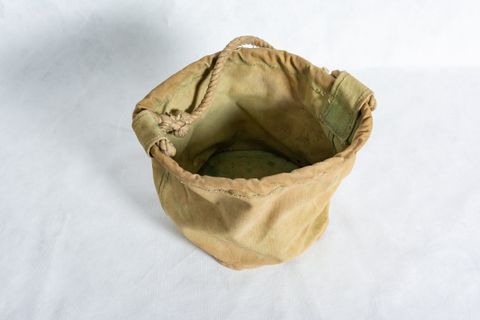
This folding water bucket was used, according to the Norfolk archive, on Guide International Service trainings during the Second World War, and then on actual expeditions after the war. The archive notes that GIS volunteers were trained to cook for large numbers with minimal equipment and to camp in harsh conditions.[1]
From camp to relief work
The Guide International Service was set up in 1942 to prepare volunteers for relief work after the war.[2] Its teams worked in displaced persons’ camps, where supplies were scarce and volunteers had to improvise.[3]
The Norfolk archive’s history of the GIS sets out what was asked of volunteers. They had to be over 21, “an experienced camper”, used to working with children and adolescents, a “Jack of all trades and master of at least one”, and hold a driving licence. “Training was harsh and included camping in mountain areas in mid-winter, transporting supplies over rough terrain in a trek cart, cooking in all weathers”.[4]
Evidence status: Interpretation An ordinary piece of camp kit becomes, here, a link between Guiding’s outdoor training and one of its most serious undertakings. Skills learned at camp (organising water, fire and food for a group) were exactly what relief work needed.
What we do not know
The archive’s own caption asks visitors: “Do you think it would be waterproof? What is it made of?” In the photograph it appears to be pale khaki canvas, with a twisted rope handle and green staining inside, but that is our reading of the image, not a catalogue description. Evidence status: Unconfirmed The archive does not say who used it or which expedition it went on, so its connection to a particular GIS team is unconfirmed.
Object story
- What is it, who made it, and when?
- A collapsible water bucket.
- Who owned or used it?
- Used by the Guide International Service.
- What did official rules say?
- GIS volunteers were trained to cook for large numbers with minimal equipment and to camp in harsh conditions. According to the Norfolk archive, they had to be over 21, experienced campers and holders of a driving licence. No official equipment list naming this kind of bucket has yet been found.
- What signs of use, alteration or repair remain?
- Visible in the photograph: green staining inside, on the base and on the outer wall; general soiling of the canvas; and frayed, untwisting rope at the knotted ends of the handle, which passes through stitched fabric tabs. The archive does not describe its condition.
- What larger story can it tell, and what can it not prove?
- It links Guiding's everyday campcraft to post-war relief work. Skills learned at camp were put to use in displaced persons' camps.
- Where is it held, what is its accession number, and what are the reuse terms?
- Girlguiding Norfolk Archive Resource Centre, Coltishall. No accession number is published. The online image is licensed CC BY-NC-SA 3.0.
Sources
- Girlguiding Norfolk Archive Resource Centre (via MyLearning), “Girl Guide Camping Water Bucket”, MyLearning. Accessed 25 September 2026. Image © Girlguiding Norfolk County Archive Resource Centre, licensed CC BY-NC-SA 3.0.
- Girlguiding, “Remembering the Guide International Service on VE Day 2025”, 2025-05. Accessed 25 September 2026.
- M. McFadzean (Museums Victoria Collections), “Guide International Service, Displaced Persons Repatriation, 1945–1951”, Museums Victoria, 2012. Read via the Internet Archive copy of September 2025.
- Girlguiding Norfolk Archive Resource Centre (via MyLearning), “Active Service by the Girl Guides in WW2”, Girl Guides: Aspects of a Fascinating History, MyLearning. Accessed 25 October 2026.