
Objects
Brownie dress altered for a new uniform
An older Brownie dress with its pockets moved up to match a newer style: evidence that someone adapted a uniform rather than buying new.
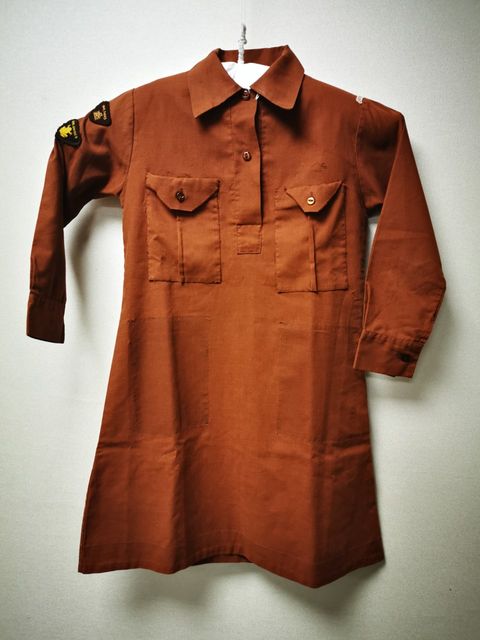
This older Brownie dress has been altered by raising the pockets to match a newer style of uniform.[1] The photograph shows the alteration plainly: the two flapped pockets now sit high on the chest, and rectangular outlines lower on the front show where they were first sewn. The object’s own entry gives no date and does not say which two styles are involved.
The archive’s history of Brownie uniform does place it. It says the dress has been “altered to match the new 1960s uniform”, and that while it has faded, the original colour can be seen where pockets once covered it.[3] Evidence status: Unconfirmed The same history says the Brownie dress of 1950 already had breast pockets, and that pocket positions changed between the 1930s and the 1950s. So it is not yet confirmed whether the alteration followed the change of 1950 or a later one, and the dress’s own date remains uncertain until it can be examined.
Why this object matters
Official histories tend to present each new uniform as if everyone switched overnight. This dress tells a different story. When the rules changed, someone (perhaps a parent, perhaps the girl herself) unpicked and re-sewed the pockets, so that the old dress would pass as the new one.
Evidence status: Interpretation That small act of sewing speaks to cost, thrift and the wish to belong. It fits a wider pattern in members’ memories of hand-me-downs, home-made items and incomplete uniforms, which this site wants to document.[2]
Object story
- What is it, who made it, and when?
- An older Brownie uniform dress that has been altered by raising its pockets to match a newer style of uniform.
- Who owned or used it?
- Not recorded.
- What did official rules say?
- We have not seen the uniform regulations themselves. According to the Norfolk archive's uniform history, the Brownie dress of 1950 had breast pockets, pocket positions changed between the 1930s and the 1950s, and this dress was altered to match the uniform of the 1960s.
- What signs of use, alteration or repair remain?
- Visible in the photograph: the two flapped pockets sit high on the chest, and stitched rectangular outlines lower on the front show where they were first sewn. The archive says the dress has faded, but the original colour survives where pockets once covered it. The two pocket buttons do not match. Badges are sewn on the upper right sleeve (the wearer's right).
- What larger story can it tell, and what can it not prove?
- It is direct evidence that uniform rules changed faster than family budgets, and that people adapted what they had.
- Where is it held, what is its accession number, and what are the reuse terms?
- Girlguiding Norfolk Archive Resource Centre, Coltishall. No accession number or date is published. The online image is licensed CC BY-NC-SA 3.0.
Sources
- Girlguiding Norfolk Archive Resource Centre (via MyLearning), “Old Brownie Dress Altered for New Uniform”, MyLearning. Accessed 25 September 2026. Image © Girlguiding Norfolk County Archive Resource Centre, licensed CC BY-NC-SA 3.0.
- Tammy M. Proctor, “(Uni)Forming Youth: Girl Guides and Boy Scouts in Britain, 1908–39”, History Workshop Journal 45, no. 1, 1998, pp. 103–134.
- Girlguiding Norfolk Archive Resource Centre (via MyLearning), “Followers of Fashion: the Brownie Uniform, Promise and Promise Badge”, Girl Guides: Aspects of a Fascinating History, MyLearning. Accessed 25 October 2026. A county archive's teaching resource; it does not cite the rules editions behind its dates.